Legalize Triple-Deckers
Every day I talk to our Boston residents about their needs, and no issue comes up more constantly than our severe housing affordability crisis.
That’s why making housing more affordable has been a constant focus in my work — from my very first legislative filing that led to the creation of the City’s $110 million Housing Accelerator Fund, continuing on to the hearing I called for a few days ago to legalize triple-deckers and other 2-4 unit homes, as one of many steps I’m taking to ensure Boston is a more affordable and equitable city.
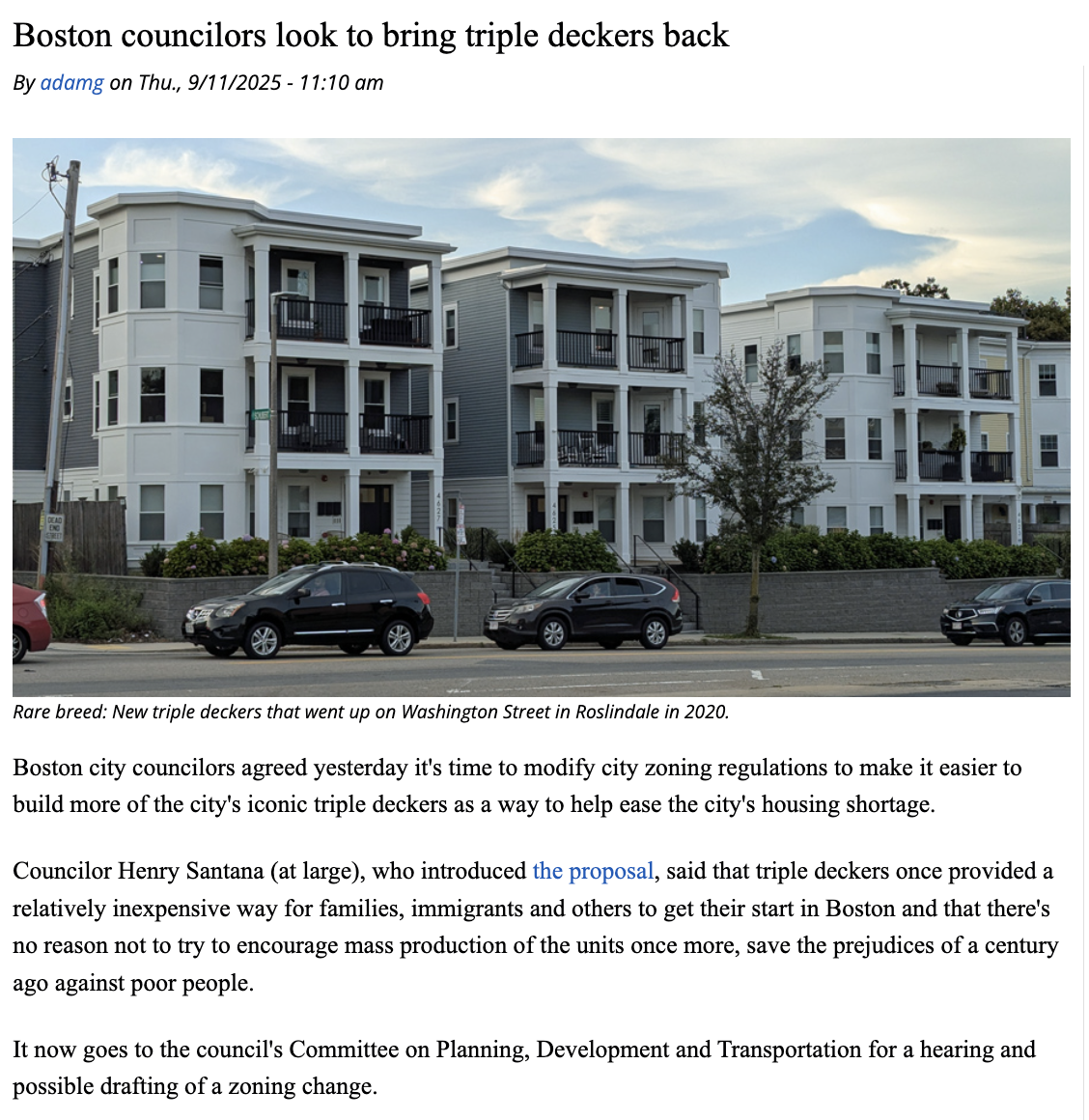
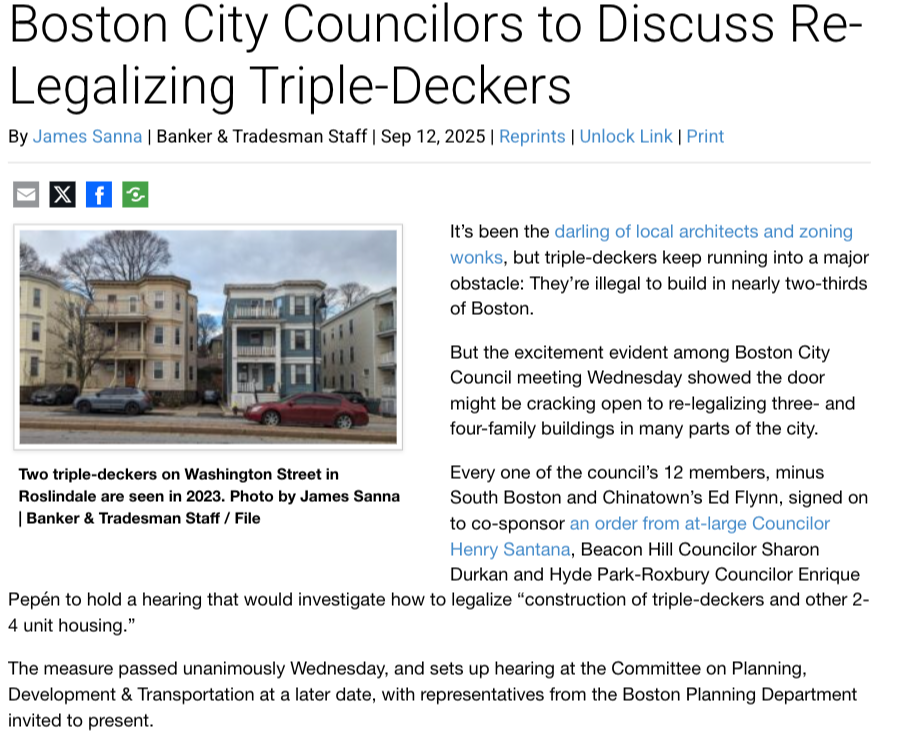
Triple-deckers are a part of Boston’s fabric, and today I want to share a deeper dive into their history, critical issues with our city's current zoning code that actually make even existing triple-deckers illegal, and the immense importance of fixing our zoning code.
The Triple-Decker & Boston's Broken Zoning Code
The triple-decker is an iconic symbol of Boston, a form of housing that historically provided a path to homeownership and affordable shelter for generations of working-class families and immigrants. Built primarily between 1880 and 1930, these homes were an elegant solution to urban density. However, for nearly a century, Boston's zoning code has effectively outlawed these buildings, even in the places they already exist.
The city's zoning code is not just long, it's a labyrinthine document of around 4,000 pages, five times the length of codes in similarly sized cities and over 1,000 pages longer than New York City's.
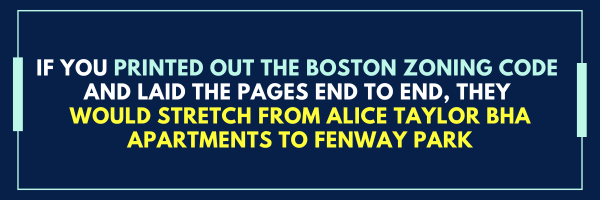
This complexity has led to a startling reality: an estimated 58% of parcels citywide fail to comply with floor-to-area ratio rules alone, just one of a giant pile of rules sprawled across 4,000 pages that prohibit building new housing — even housing identical to existing homes.
The idea that the Boston zoning code considers the majority of our homes to be illegal should concern everyone.
If you live in Boston, odds are, you couldn’t legally build the home you live in where you live.
The process to overcome our broken Boston zoning is so difficult and costly — requiring variances and legal experts — that it heavily favors large developers who can afford to dump money into lawyers and consultants, sidelining smaller builders and individual homeowners. And those costs just get passed onto us when we go to rent or buy those homes.
These regulations make it nearly impossible to build new 2- to 4-unit homes like triple-deckers, even where they already exist.
All this adds up to less housing, at higher costs for our Boston communities.
Boston's Housing Crisis:
A Context of Scarcity and High Costs
This outdated code, with many restrictions originating from the 1930s-1960s, was often intentionally designed to limit housing for immigrant and working-class families. Today, it still works against us. It makes it nearly impossible for our residents to build the kind of moderate-scale, multi-family homes that our neighborhoods were built on.
Boston is in the midst of a profound housing crisis. The city's housing market is characterized by alarmingly high costs, with median home prices and rents among the highest in the nation.
This crisis is fueled by a severe imbalance between housing supply and demand. Since 2010, while the production of large housing developments (5+ units) has increased, the construction of "missing middle" housing — such as triple-deckers — has lagged dramatically.
The rate of production for 3- to 4-unit homes is a mere one-fifth of that for single-family homes and one-tenth of that for larger developments. This has left a significant gap in the market, pushing many families and individuals out of the city in search of more affordable options.
Why Legalizing Triple-Deckers is a Crucial Step
Legalizing triple-deckers and other small-scale multi-family housing is a vital part of the solution to Boston's housing crisis.
Promoting Affordability: These housing types offer a crucial entry point for moderate-income residents and families. They provide a more affordable alternative to both expensive single-family homes and large luxury developments, diversifying the housing stock and addressing the "missing middle."
Empowering Homeownership: Triple-deckers have historically allowed for generational wealth-building. Owners could live in one unit while renting out the others to help pay the mortgage, a model that remains highly relevant today.
Preserving Neighborhood Character: This initiative is about building upon existing neighborhood fabric. It allows for a human-scaled, dense, and walkable urban form that respects the city's unique architectural heritage.
Encouraging Sustainable Growth: By promoting density in existing neighborhoods, the city can reduce reliance on cars, lower per-capita energy consumption, and support local businesses, all of which contribute to a more sustainable urban environment.
With 49 square miles of land, we don't need
82 pages of zoning code per square mile.
We need common-sense reforms that allow us to build the housing our residents need and want. I am committed to working with my colleagues and the community to push for these changes and help create a city where more people can afford to live and thrive.